幼兒運筆練習的發展科學:為什麼手寫描紅是手眼協調與大腦發育的重要基礎?
📅 發表日期: 2026-05-24
✍️ 作者: Kiddo Task 育兒科學團隊
在人人都習慣以鍵盤打字、指尖點滑螢幕的數位時代,實體手寫似乎逐漸被邊緣化。許多家長為了跟上科技潮流,早早就讓幼兒接觸平板電腦上的認字與英文小遊戲。然而,發展心理學與認知神經科學的研究顯示,過早且完全以電子螢幕點滑取代傳統紙筆手寫,容易影響幼兒精細動作的發育與手眼協調能力。
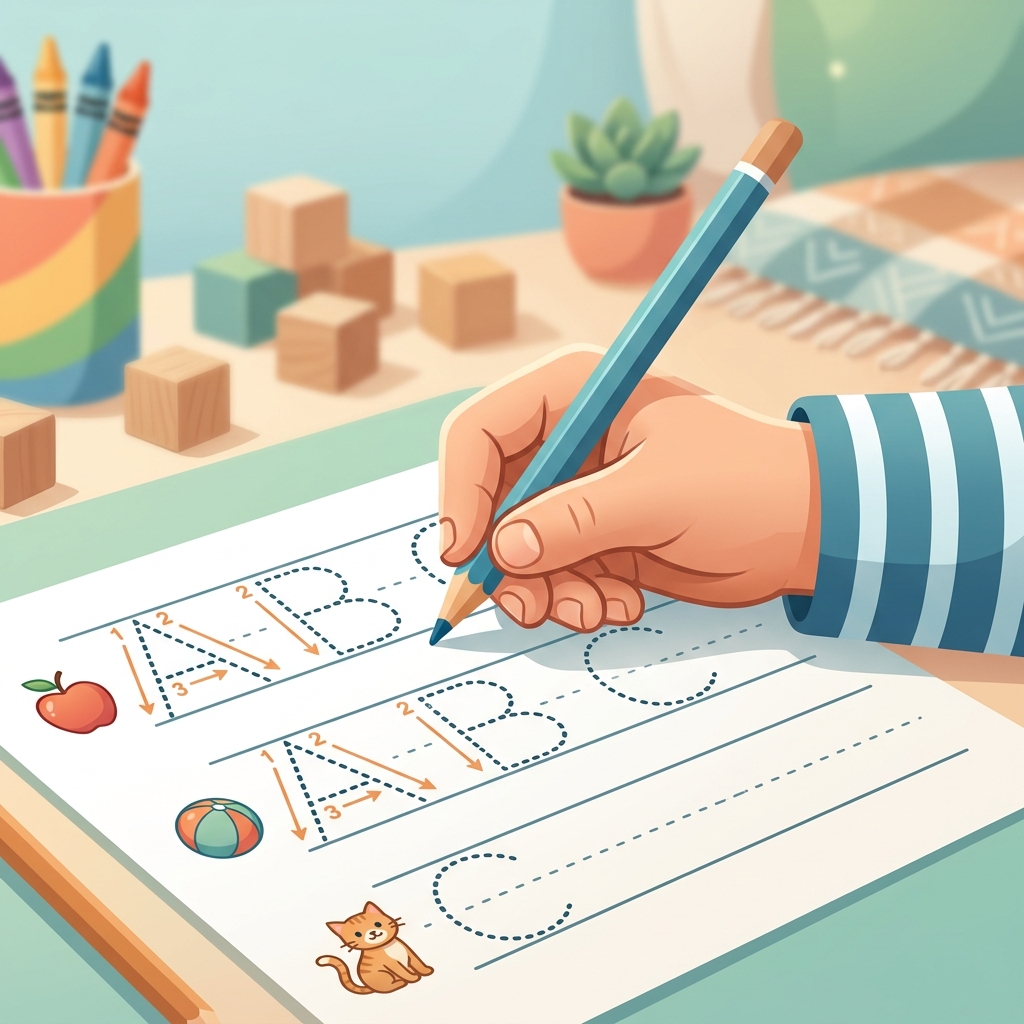
當四歲的孩子拿著實體鉛筆,專注地沿著練習紙上的虛線描摹字母時,他們的手部肌肉、視覺系統與大腦感覺皮質正共同進行一場細緻的協同練習。這不僅是寫字,更是鍛鍊空間感與專注力的過程。本文將從生理發育、蒙特梭利教學觀點以及感官整合的層面,說明英文運筆練習對幼兒成長的實質幫助。
「手是大腦顯露於外的部分。幼兒透過雙手的實體工作,能在腦海中逐漸建構起對空間、秩序與邏輯的認知。」(兒童教育家 瑪麗亞·蒙特梭利)
一、腕骨發育與握筆姿勢的生理規律
許多家長看到三歲左右的孩子寫字歪歪斜斜,或者用整隻手用力抓握筆桿,會感到焦慮並急著糾正。其實,這符合幼兒手部骨骼發育的自然規律,家長不需要過度擔心。
幼兒的手部骨骼尚未發育完全。幼兒的腕骨在出生時大多是軟骨,要到六歲左右才會逐漸鈣化成熟。同時,手指的細微肌肉也比較容易疲勞,因此孩子的控筆姿勢會經歷三個自然發展階段:
- 兩到三歲(掌心朝下握姿):孩子此時主要靠整條手臂的揮動來畫畫或塗鴉,這對大肌肉的穩定度很有幫助。
- 三到四歲(四指抓握姿):孩子開始用大拇指、食指、中指和無名指捏筆。這是精細動作的過渡期。
- 四到六歲(動態三指握姿):也就是用大拇指與食指夾筆,中指在下方支撐,無名指與小指自然彎曲來提供穩定性。這是最省力也最能靈活控筆的姿勢。
我們的運筆與單字練習單提供適當字級的字母與單字,能配合孩子的生理發育,讓四到六歲的孩子在練習中逐漸適應三指握筆的肌肉習慣,避免造成手部負擔。
二、蒙特梭利教育的「書寫敏感期」
蒙特梭利指出,幼兒大約在三歲半到四歲半之間,會進入一個對符號和描摹極感興趣的「書寫敏感期」。在這段時期,孩子對觸摸周圍的字體、描繪線條邊緣有很高的熱情。
在蒙特梭利教室中,常見的「砂紙字母板」教具,就是讓孩子用手指指腹摩擦粗糙的砂紙邊緣,透過觸覺來感知字形。實體的紙筆運筆描紅練習也是相同的原理,它能將視覺的字母形狀與手部動作結合,幫助孩子在開始學習閱讀之前,先透過觸覺與動作建立對字形的印象。這比單純在螢幕上看著字元,更能留下深刻的學習痕跡。
三、紙筆摩擦的觸覺回饋對大腦的幫助
近年來許多發展心理學與神經科學的觀察發現,當孩子拿鉛筆在稍微有粗糙度的紙張上書寫時,筆尖產生的微小物理阻力,會透過指尖的機械感受器向大腦傳遞豐富的本體感覺回饋。
這種觸覺回饋與雙眼盯著虛線的視覺、控制手腕的運動系統相互配合,形成多感官的學習過程。相比之下,光滑的平板螢幕無法提供這種摩擦阻力,指尖的滑動刺激較為單一。此外,實體的紙筆練習沒有螢幕藍光與聲光特效的干擾,能讓孩子處於比較安靜的專注狀態,有助於培養專注力,對大腦前額葉的發展也有正面影響。這也是為什麼紙筆練習在幼兒發展中,有著數位科技無法取代的獨特價值。
四、循序漸進的家長引導指南
在陪伴孩子練習運筆時,建議家長採取溫和、漸進的方法,不要操之過急。您可以使用 Kiddo Task 的英文運筆與單字練習單生成器,依照以下三個步驟來引導孩子練習:
- 第一步:字母描紅與發音的結合:
您可以先選擇字母模式,列印出大寫或小寫字母的虛線練習單。當孩子描摹字母時,引導他們發出該字母的自然發音(例如描摹 S 時念出 /s/ - /s/ - sun),把形狀、寫法與發音聯結在一起,能讓字母記憶更深刻。
- 第二步:單字練習與空間感培養:
當孩子能熟練描紅單個字母後,可以換成單字模式,列印蘋果(APPLE)或風箏(KITE)等常見單字。這能讓孩子觀察字母之間的間距與排版,幫助他們在練習中理解字與字之間的空間關係,為未來的書寫習慣奠定基礎。
- 第三步:著重過程的具體鼓勵:
當孩子寫得不夠直或超出虛線時,不需要急著糾正或擦掉。家長可以多給予具體的讚美,例如:「我看到你今天很專心地握筆,把這排 S 寫完了,你很努力喔!」這樣的正向回饋能提升孩子的信心與成就感,讓他們將書寫練習視為一件有趣且有成就感的事情,樂於繼續嘗試。
您可以現在就使用我們的 英文運筆與單字練習卷生成器,為孩子量身製作適合的練習紙,一鍵下載列印,陪伴他們在乾淨的紙張上踏實地練習,建立手寫的自信。
The Developmental Science of Childhood Tracing: Why Handwriting Practice is Essential for Fine Motor and Brain Development
📅 Date: 2026-05-24
✍️ Author: Kiddo Task Pediatric Science Team
In an age dominated by keyboards, touchscreens, and digital interfaces, physical handwriting is often regarded as a legacy skill that is slowly fading from our daily lives. Many well-meaning parents, eager to help their kids adapt to the digital age, introduce tablets to toddlers for spelling and letter identification games very early. However, extensive research in developmental psychology and pediatric cognitive neuroscience suggests that prematurely replacing physical writing with touchscreens can impact children's fine motor skills and sensory integration.
When a young child holds a physical pencil and focuses on tracing dotted letters on a sheet of paper, their hand muscles, visual system, and brain motor areas are working in harmony. Tracing lines and letters is a complex developmental milestone that helps children construct a mental map of spatial layout, order, and coordination. This article explores the physiological, developmental, and sensory benefits of preschool English tracing worksheets, and how physical pencil-on-paper practice helps children develop key neural pathways.
"The hand is the instrument of man's intelligence. Through hands-on movement and sensory experience, children build their understanding of order, space, and reasoning," noted Maria Montessori.
1. The Physiology of Fine Motor Skills: Carpal Ossification and Pencil Grip
It is very common for parents to feel anxious when they observe a 3-year-old child writing crooked lines or holding a pencil tightly with a closed fist. However, this concern is physiologically misplaced. This is a perfectly normal part of early muscle development, and children should be allowed to progress naturally.
A preschooler's hand bones are physically immature. A toddler's wrist consists almost entirely of soft cartilage, which gradually undergoes ossification, calcifying into hard bone, up until about age six. The small muscle groups in their fingers also tire very quickly. As a result, a child's grip naturally progresses through three distinct developmental stages as they grow:
- Pronated Palm Grip (Ages 2-3): The child uses their entire arm and shoulder to guide the pencil. Letting them draw large lines and shapes helps build larger shoulder and elbow joint stability, which acts as the physical foundation for finer movements.
- Quadrupod Pinch Grip (Ages 3-4): A 4-point grip utilizing the thumb, index, middle, and ring fingers. This is the crucial transitional phase of fine motor refinement, helping the child learn to apply varying levels of pressure.
- Dynamic Tripod Grip (Ages 4-6): Precision control using the thumb and index finger to pinch the barrel, with the middle finger resting underneath for support while the ring and pinky fingers tuck inward to stabilize the palm. This is the most ergonomic and efficient grip posture.
Our tracing generator provides letters and words of appropriate size, allowing children ages 4 to 6 to practice their grip without straining their developing joints and finger muscles.
2. The Montessori Approach: Fostering the "Sensitive Period for Writing"
Dr. Maria Montessori observed that between the ages of three and a half and four and a half, children enter a profound phase known as the "Sensitive Period for Writing." During this window, they display a natural, intense fascination with touching shapes, tracing contours, and exploring written symbols.
In a Montessori classroom, children interact with "Sandpaper Letters" before they even begin reading. By tracing their fingers along the textured sandpaper surfaces, they connect tactile resistance with visual shapes, effectively teaching their hands the physical pathways of writing. Physical paper-based tracing worksheets operate on the same principle, combining visual letter forms with motor patterns. This process helps children build a concrete mental map of letters through touch and movement before academic reading begins, bridging the gap between perception and action.
3. Proprioception and Tactile Feedback: Why Paper Beats Glass Screens
Recent studies in developmental neurology suggest that when a child writes with a physical pencil on paper, the physical friction between the lead and the paper surface creates micro-sensory inputs. These signals are picked up by the mechanical receptors in the fingertips and sent back to the parietal lobe of the brain.
This rich tactile feedback integrates with visual input (watching the lines) and motor movement, creating a multisensory experience. Smooth glass screens lack this tactile resistance, offering a uniform glide that does not provide the same sensory feedback. In addition, physical paper sheets are free from screen glare and flashing digital rewards, creating a calmer environment that allows children to practice deep focus. This simple, distraction-free concentration is highly beneficial for prefrontal cortex development and building longer attention spans, helping children learn to self-regulate and sustain cognitive focus.
4. A Practical Guide for Parents
When introducing handwriting practice to your child, it is best to take a gentle, step-by-step approach. Using the Kiddo Task Preschool English Tracing Worksheet Generator, parents can guide their children using these three simple steps:
- Step 1: Phonics and Stroke Integration:
Start by choosing "Letter Mode" to print out large uppercase or lowercase dotted letter sheets. As your child traces each letter, guide them to make its corresponding phonics sound (such as saying "/s/ - /s/ - sun" while tracing "S"). Combining the visual shape, the physical movement of tracing, and the sound of the letter makes learning natural and effective.
- Step 2: Word Tracing and Spatial Spacing:
Once your child is comfortable tracing individual letters, switch to "Word Mode" and print worksheets featuring simple words like "APPLE" or "KITE." This helps them observe letter spacing and understand the physical distance between words, which is a key skill for future sentence writing.
- Step 3: Process-Oriented Praise:
Avoid pointing out every minor error or tracing outside the lines. Instead, encourage their concentration and persistence by saying: "I love how carefully you held the pencil today to finish this page. You worked really hard on this!" Specific, process-oriented praise builds self-confidence, helping children view handwriting practice as a rewarding and enjoyable activity they want to continue.
You can visit our Preschool Tracing Worksheet Generator today, customize a free worksheet, and print it out. Join your child on this quiet, tactile journey of sensory-motor development and self-discovery!