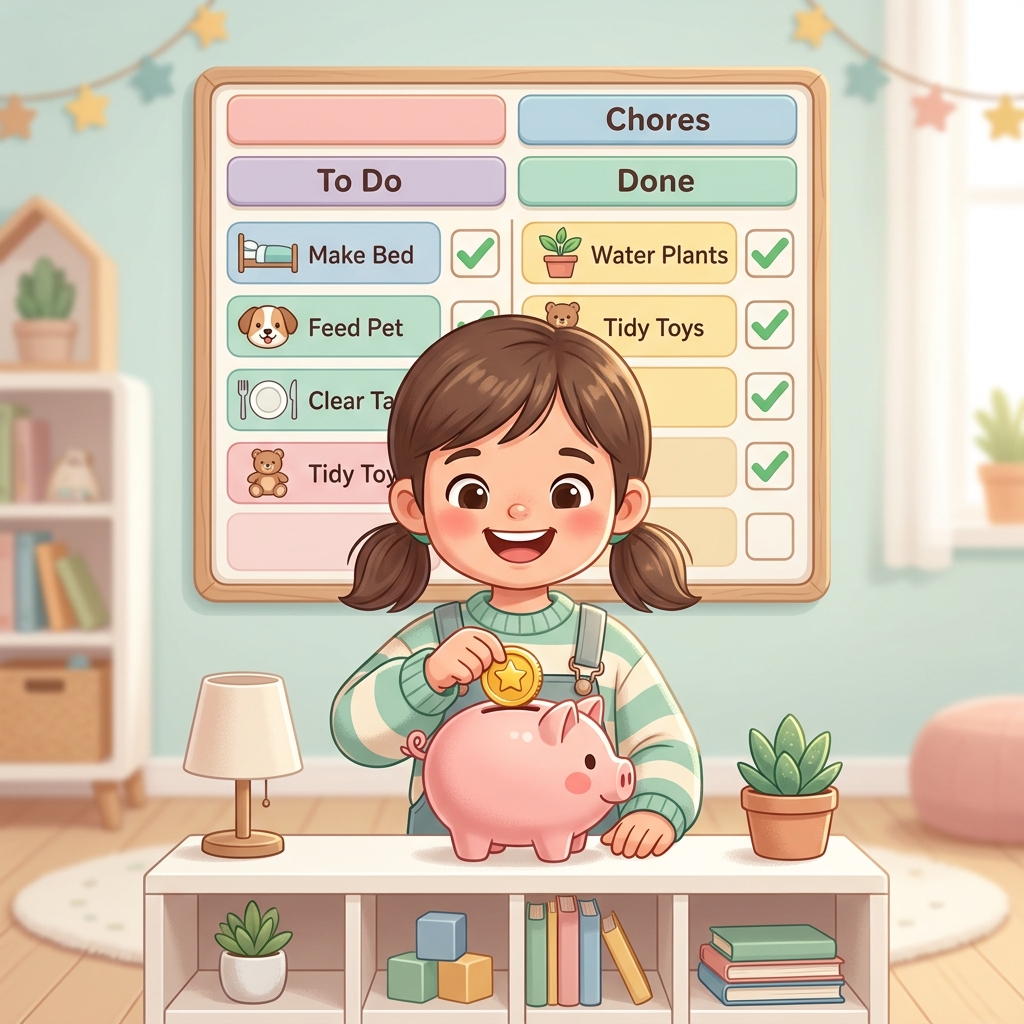
理財與家事表:運用代幣制度與阿德勒心理學培養孩子的責任感
📅 發表日期: 2026-05-24
✍️ 作者: Kiddo Task 育兒科學團隊
「快去收玩具!」、「衣服怎麼又亂丟!」這些每天在家中上演的催促聲,常讓許多父母感到身心俱疲。許多家長為了讓孩子主動參與家務,會嘗試用口頭命令或隨機的物質獎勵,但結果往往演變成親子間的討價還價。是否有更合適的方法,能讓孩子在日常中建立主動性,同時學會自律與感恩?
其實,做家事不只是分擔家務,更是幼兒鍛鍊手腦協調、空間感與責任感的良好機會。今天我們將結合阿德勒心理學、行為學派的代幣制度(Token Economy)與早期理財觀念,探討如何運用視覺化家事表,以溫和且科學的方法引導孩子養成良好習慣。
「當孩子感到自己對共同體有所貢獻,且這種貢獻被看見時,他才能感受到自身的價值,建立真正的自信與自律。」(兒童心理學家 阿爾弗雷德·阿德勒)
一、阿德勒心理學:在日常家事中建立共同體意識
阿德勒心理學強調,人類的幸福感來自於「共同體感覺」,也就是感受到自己是群體中不可或缺、有價值的一份子。對於幼兒來說,家庭就是最核心的共同體。
當家長包辦所有家務、拒絕讓孩子參與時,孩子可能會覺得自己只是家裡的被動消費者,甚至覺得自己無能。相反地,如果家長能根據孩子的年齡,安排適當的家務(例如吃完飯幫忙擦餐桌、把髒衣服分類放進洗衣籃),並在他們完成後給予具體的感謝,孩子就會產生強烈的貢獻感。他們會明白,透過自己的雙手,可以讓家裡變得更整潔,這對建立自信心非常有幫助。
二、行為代幣制度:將抽象習慣轉化為具體回饋
在行為心理學中,代幣制度是一種廣泛應用於習慣養成的方法。其原理是:當孩子表現出期望的良好行為時,立刻給予視覺化的代幣(例如蓋章、貼紙或積分分數),累積到一定數量後,即可兌換事先約定好的小獎勵。
這非常符合幼兒的認知發展規律。對於年幼的孩子而言,「下個月帶你去遊樂園」這種類型的長遠約定過於抽象且遙遠,難以維持當下的動力。而在冰箱或牆上貼一張能隨時記錄點數的家事表,則能把家長的期望轉化為即時、看得見的回饋。每當點數增加時,這種正向的視覺刺激會鼓勵孩子感受到進步的喜悅,從而樂於重複該行為。這也是我們家事表設計的初衷。
三、早期理財與數感訓練:從小理解付出與回報
如何給予孩子零用錢常是家長的難題。如果無條件給予,孩子容易忽略金錢的價值;如果完全不給,孩子又失去練習做財務決策的機會。我們建議將家務劃分為「基本義務」與「額外貢獻」兩類:
- 基本義務(無金錢獎勵):也就是身為家庭成員的基本責任,例如整理自己的床鋪、準備自己的書包。這些行為不應該與金錢或點數掛鉤,因為這是孩子自我管理的一部分。
- 額外貢獻(可獲得小獎勵):也就是超出個人範疇、為全家人服務的事務,例如幫忙擦全家的鞋子、掃客廳、擦洗低矮的玻璃窗。這些家務適合給予相應的小額點數或零用錢作為獎勵。
透過付出勞動獲得回報的過程,孩子不僅能建立健康的勞動與金錢觀念,還能在統計報酬、規劃儲蓄的過程中鍛鍊基本的數感與邏輯。例如思考「每天幫忙拿餐具可以得1點,要存幾天才能換到我想要的50點故事書呢?」這樣的實務思考,比單純在紙上算算術更具生活實用價值。
四、蒙特梭利日常教育:不同年齡段的家事建議
為了避免任務難度過高帶來挫折感,家長應配合孩子的發育階段,提供適合的家事項目:
- 兩到三歲 (精細肌肉與模仿期):此時孩子喜歡模仿。可安排「把髒衣服丟進髒衣籃」、「幫忙拿紙巾」、「收拾自己的玩具」。
- 四到五歲 (協調習慣養成期):手腕力道增強。可安排「用小噴瓶給植物澆水」、「配對分類襪子」、「擦低矮桌椅」、「幫忙排碗筷」。
- 六到八歲 (責任感養成期):進入學齡段。可安排「掃地拖地」、「摺自己的衣物」、「每天倒垃圾與分類」、「整理書包」。
- 九歲以上 (生活技能熟練期):可安排「清洗碗盤」、「準備簡單早餐」、「更換個人被單」、「使用洗衣機與晾衣」。
五、循序漸進的引導步驟
在引入家事獎勵表時,建議家長採取以下三個步驟,以確保習慣養成過程溫和且有效:
- 1. 共同制定規則:
不要直接把寫好的表格丟給孩子,這會讓他們覺得是負擔。家長可以和孩子坐下來,打開 Kiddo Task 的 兒童家事獎勵表,共同商量哪些是基本義務,哪些是可以獲得獎勵的家事,並一起決定各項家事的獎勵點數,這能讓孩子感受到被尊重與信任。
- 2. 少量引進,由易到難:
一開始不要塞滿整張表格。建議先從每週一到兩項非常簡單的任務開始(例如吃完飯擦自己的桌子),等孩子適應並建立起成就感後,再慢慢增加項目的數量或難度。
- 3. 肯定努力的過程,而不過度挑剔結果:
當孩子桌子擦得不夠乾淨、衣服摺得歪歪斜斜時,請家長先克制批評或動手重做的衝動。請對著他們的努力微笑,並給予具體的感謝:「謝謝你今天幫忙擦桌子,你非常用心,這讓我們的餐桌變得好乾淨!」具體的感謝與鼓勵,往往比物質的代幣更能帶給孩子深層的自信。
歡迎現在就前往我們的 我是賺錢小幫手家事表生成器,與孩子一同設計專屬家事卡並列印出來,陪伴孩子在負責、感恩與自信中快樂成長。
Chores and Allowance: Fostering Children's Sense of Responsibility Through Token Economy and Adlerian Psychology
📅 Date: 2026-05-24
✍️ Author: Kiddo Task Pediatric Research Team
"Go clean up your toys right now!" "Why are your clothes scattered all over the floor again?" These daily nagging reminders are exhausting for parents and teachers alike. Many well-meaning parents rely on verbal warnings or random physical rewards to encourage their children to help with chores. However, these methods often lead to continuous bargaining and frustration. Is there a more effective way to encourage children to participate in chores while building self-discipline and gratitude?
In reality, helping with household chores is not just about reducing the workload for parents; it is a valuable developmental opportunity. Doing chores helps children practice coordination, visual sorting, and logical thinking. Today, we will integrate Alfred Adler's psychology, behavioral Token Economy principles, and early childhood financial education to discuss how a visual chore chart can support active, positive routines.
"Only when a child feels that they contribute to the community, and that this contribution is recognized, can they feel their own worth and develop genuine self-confidence and self-discipline," noted psychologist Alfred Adler.
1. Adlerian Psychology: Building a Sense of Community Through Everyday Chores
According to Adlerian psychology, true happiness stems from a sense of belonging and community connection, which is the feeling that you are a valued, helpful member of a group. For young children, the family is the first and most important community.
When parents do everything and handle every single chore, they unknowingly send a discouraging message to their children that they are passive consumers, or that their help is not needed. On the contrary, when parents assign age-appropriate household chores (such as sorting laundry or wiping dining tables) and express genuine appreciation, children feel a strong sense of contribution. They realize that their hands can make their home a cleaner and more comfortable place, which is highly beneficial for building healthy self-confidence.
2. The Behavioral Token Economy: Visualizing Success to Build Positive Habits
In behavioral psychology, a Token Economy is a widely recognized method for habit formation. The core concept is simple: when a child displays a desired positive behavior, they immediately receive a visual token (such as a sticker, a stamp, or a numerical point). Once they collect a certain number of tokens, they can exchange them for a pre-negotiated reward.
This approach is highly aligned with a child's cognitive development. For young children, long-term promises like "we will visit the amusement park next month if you are good" are too abstract and distant to maintain daily motivation. In contrast, having a visual chore chart on the refrigerator that tracks daily points turns abstract expectations into immediate, visible progress. Each time points are earned, the visual success encourages children to feel proud of their contribution, making them excited to repeat the behavior. This is the scientific foundation of the Kiddo Task visual chore chart generator.
3. Early Financial Literacy: Teaching the Connection Between Effort and Reward
Determining how to distribute pocket money or small rewards can be challenging for parents. Giving money unconditionally may prevent children from understanding the value of work, while giving none deprives them of the chance to practice financial decision-making. We recommend dividing household tasks into two distinct categories:
- Core Duties (Unpaid): Slicing through personal tasks, like making one's bed, packing one's school bag, or organizing personal toys. These are baseline responsibilities of being a family member and should never be tied to monetary rewards or points.
- Extra Contributions (Paid): Contributing to the household, like sweeping the living room, sorting family laundry, or washing vegetables for dinner. These go beyond personal boundaries and are rewarded with points or allowance.
By experiencing this connection between effort and reward, children develop a healthy relationship with money. Budgeting their points to purchase a desired toy (e.g., "If I earn 3 points a day by helping out, how many days will it take to save up for this 30-point storybook?") builds practical mathematical skills and financial responsibility in a highly functional context.
4. A Montessori Guide: Age-Appropriate Chores for Young Minds
To prevent children from feeling discouraged by overly difficult tasks, parents should align chores with their child's physical and developmental milestones:
- Ages 2 to 3 (Fine Motor & Mimicry): Toddlers love doing what parents do. Suitable tasks include "putting dirty clothes into the hamper," "helping fetch napkins," and "returning personal toys to the toy bin."
- Ages 4 to 5 (Hand-Eye Coordination): Wrist strength increases. Children in this phase can handle tasks like "watering plants with a small spray bottle," "matching and sorting clean socks," "wiping low tables and chairs," and "setting the dinner table with plates and spoons."
- Ages 6 to 8 (Logical Thinking & Responsibility): Elementary school prep. Suitable chores include "sweeping and mopping floors," "folding personal clothes," "taking out the trash and sorting recycling," and "packing their school backpack before bed."
- Ages 9 and above (Life Skills Mastery): Preparing for independence. They can help with "washing dishes after meals," "preparing a simple breakfast," "changing their own bedsheets," and "using the washing machine and hanging clothes to dry."
4. Step-by-Step Practical Parent Support Guide
When implementing a visual reward chart, we suggest following these three steps to ensure a positive and sustainable experience:
- 1. Collaborate on the Rules:
Avoid handing down a fully completed chart. Instead, sit down together, open the Kiddo Task Kids Chore Chart, and ask: "Which chores do you feel ready to take on to help our family?" Collaborating builds a powerful sense of ownership.
- 2. Introduce Gradually, One Step at a Time:
Do not overwhelm your child with too many tasks. Begin with one or two simple daily tasks (such as clearing their plate after dinner). Once these habits become natural and automatic, slowly introduce more advanced chores.
- 3. Appreciate the Effort, Not Just the Result:
If a table is slightly damp or a shirt is folded unevenly, resist the urge to criticize or re-do it in front of them. Smile and say: "Thank you for wiping the table! I saw how carefully you worked, and you made our dining room look wonderful." Focused, process-oriented encouragement is far more powerful than punishment.
You can visit our Chore Chart Generator today, customize a chore card with your child, print it out, and support them on their journey toward responsibility and self-confidence!