分數學習與兒童發展:如何透過幾何圖示建立分數概念?
發表日期: 2026-05-24
作者: Kiddo Task 育兒科學團隊
當孩子開始學習小學數學時,家長們最常碰到的第一個瓶頸通常不是加減乘除,而是分數。許多原本心算速度極快的孩子,在碰到 1/2 和 1/3 時,會直覺地認為「3比2大,所以 1/3 大於 1/2」。這種將分數視作獨立整數進行比較的錯誤,常被稱為「整數偏誤」。
這主要是因為分數要求孩子理解「相對關係比率」,是一次概念上的轉變。如果此時強迫孩子背誦「通分」、「交叉相乘」等抽象規則,容易增加學習的挫折感。今天我們結合皮亞傑認知理論與新加坡數學 CPA 三階段教學法,說明合適的分數引導方式。
發展心理學研究指出:「孩子的大腦並非等待灌輸公式的容器,而是需要具體感官經驗作為基礎。沒有圖像做為地基,抽象的數學觀念將難以穩固。」
一、皮亞傑認知階段:大腦如何理解比例
心理學家皮亞傑(Jean Piaget)指出,小學階段 of 兒童大多處於具體運算階段。在此階段,孩子的抽象邏輯推理能力才剛起步,高度依賴看得見、摸得到的具體物件來輔助邏輯運算。
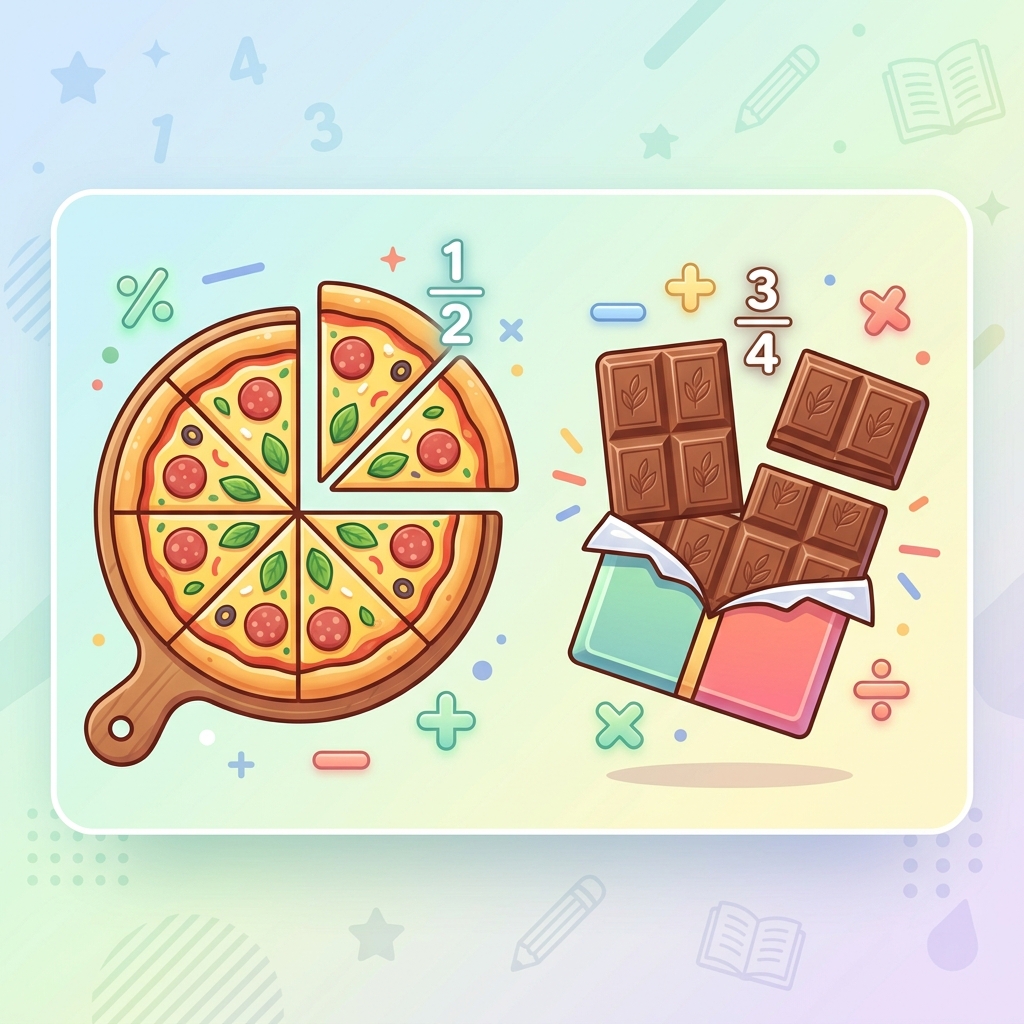
當老師在黑板上寫下 3/4 時,對孩子來說只是兩個被橫線隔開的數字。孩子大腦較難直接將這兩個數字與現實世界數量關係作連結。如果能給予圓形披薩或長條巧克力的視覺模型,大腦的工作記憶就能迅速理解「分母是切成幾份,分子是拿走幾份」。因此,視覺化的分數教具是孩子理解概念的重要基礎。
二、新加坡數學 CPA 教學法:具象、圖像、抽象的三步驟
新加坡數學的核心在於將認知發展理論轉化為步驟化的 CPA 教學法:
- 1. Concrete(具象化):藉由實體食物或教具進行學習。例如在廚房中讓孩子親手將吐司或披薩分成 4 等份,體會平分的真實物理動作與公平性。這種身體觸覺體驗是建立數感的起點。
- 2. Pictorial(圖像化):將實物轉化為圖形的關鍵步驟。由於考試時無法使用實物,必須過渡到二維圖示。圓形與長條形是兩種最經典的圖像模型:
- 🍕 圓形披薩模型:利用圓形的向心力與對稱性,非常直觀地呈現「部分與整體」的關係,適合初學者建立最初步的認識。
- 🍫 長條巧克力模型:長度是一維的。在比較分數大小(如比較 3/4 與 5/8)時,比對直線長度差異比辨識圓餅圖的扇形面積差異容易得多,能降低大腦處理幾何視覺時的負擔。
- 3. Abstract(抽象化):在孩子對圖像模型相當處理後,最後一步才引入符號寫法。這時,符號對他們而言是具體的披薩片數與巧克力長度,而不再是死板的規則。
三、實實紙筆手寫的感官學習特點
許多家長會下載平板遊戲讓孩子練習分數。雖然畫面生動,但神經科學研究指出,在玻璃螢幕上滑動的單調動作,對大腦皮質的刺激相對有限。
相反地,使用紙筆列印的分數練習卷,要求孩子手握鉛筆,順著線條分割圖案,或用色筆在格子內進行塗色練習。在此過程中,手指微細肌肉在對抗紙張物理阻力時,會產生精細的觸覺回饋。
這種觸覺、肌肉活動與眼睛視覺的同步協同,有助於加深長期記憶,極大地強化了孩子對分數大小的直覺數感。
四、引導步驟建議
想讓孩子理解分數,家長可以善用我們的免費線上 分數披薩工廠生成器,並參考以下三個引導步驟:
- 第一步:實體物品分割(具象熱身):
在吃早餐或下午茶時,拿一片吐司或一條巧克力棒,交給孩子安全的餐刀,說:「我們有 3 個人要分,請幫我平分成 3 份。每個人拿到的那一份,就是三分之一(1/3)。」強調每一份必須一樣大。
- 第二步:圖像塗色練習(圖像架構):
打開我們的 分數披薩工廠,選擇「Level 1(分母為 2, 4, 8)」,題型選擇「塗色練習 (Coloring)」。列印出練習卷後,指著題目上的 3/4 說:「這塊巧克力被切成了 4 塊(分母),分子是 3,代表我們要塗滿 3 格。」讓孩子在著色中理解分子與分母的關係。
- 第三步:寫出分數與比大小(抽象內化):
熟練後改為生成「寫出分數 (Identify)」與「比大小 (Compare)」的練習。當孩子在比大小猶豫時,切勿直接灌輸「交叉相乘」的口訣!引導孩子在旁邊畫出兩個相同長度的巧克力長條,一個分成 3 格塗 2 格,一個分成 5 格塗 3 格,然後問他:「看一看,哪一個比較長?」這種視覺上的自主發現能讓概念更穩固。
歡迎前往我們的 分數披薩工廠練習卷生成器,免費生成並下載列印練習單,陪伴孩子一起輕鬆克服分數這道難關。
Fractions and Child Development: Building Math Sense with Visual Models
Date: 2026-05-24
Author: Kiddo Task Pediatric Research Team
When children begin their mathematics journey, fractions can often be a major challenge for parents. Many children who are fast with basic arithmetic struggle when encountering fractions like 1/2 and 1/3, claiming that since 3 is larger than 2, 1/3 must be greater than 1/2. In education, this tendency to treat fractions as independent integers is known as the whole number bias.
Why do children find this concept so difficult? The answer lies in the shift fractions demand: moving from counting whole items to understanding relative proportions. Forcing children to memorize abstract formulas like finding common denominators without visual models can easily cause math anxiety. Today, we will integrate Piagetian development theory and Singapore Math's CPA approach to reveal a natural path for teaching fractions.
"A child's mind is not a vessel to be filled with algorithms, but a structure built on concrete experiences. Without a pictorial foundation, abstract mathematical concepts will remain difficult to grasp." (Pediatric Cognitive Research Group)
1. Piaget's Cognitive Stages: How the Brain Decodes Ratios
Swiss psychologist Jean Piaget pointed out that primary school children are in the concrete operational stage. During this phase, children's logical reasoning skills rely heavily on concrete objects they can see, touch, and move.
When a teacher writes 3/4 on a whiteboard, it appears to a young student as merely two numbers separated by a line. A child's brain cannot automatically map these numbers to real-world quantities. However, by introducing a circular pizza or a chocolate bar model, the child's memory gains an immediate anchor, understanding that the denominator is the total pieces, while the numerator is the pieces taken. Visualized fraction resources are a key foundation for young students.
2. Singapore Math's CPA Methodology: A Three-Stage Mastery
Singapore Math consistently yields strong results because it translates cognitive psychology into a structured CPA (Concrete-Pictorial-Abstract) method:
- 1. Concrete Stage: Learn through physical actions. In the kitchen, let the child slice a pizza or toast into equal shares to feel the physical meaning of equal partitioning. This physical experience forms the baseline of early number sense.
- 2. Pictorial Stage: The vital bridge that translates physical objects into drawings. Since students cannot bring actual pizzas to a test, they must transition to visual models:
- 🍕 Circle (Pizza) Model: Leveraging radial symmetry, the pizza model provides an intuitive representation of "part-to-whole" relations, which is ideal for beginners to grasp foundational fraction concepts.
- 🍫 Bar (Chocolate) Model: Length is linear and unidimensional. When comparing sizes (e.g., comparing 3/4 and 5/8), it is significantly easier for the visual cortex to compare linear lengths than radial areas, drastically reducing mental strain.
- 3. Abstract Stage: Introduce written symbols only after children exhibit a strong grasp of the pictorial models. Now, fractional notation represents a vivid mental image of pizza slices or chocolate bars rather than dry, arbitrary rules.
3. Multisensory Encoding: Why Physical Worksheets Beat iPad Apps
Many parents introduce educational apps on tablets to teach fractions. While interactive and colorful, cognitive neuroscientists point out that simple tapping and dragging motions on a smooth glass screen provide minimal stimulation to the brain's sensorimotor cortex.
Conversely, utilizing printed fraction worksheets requires children to hold a physical pencil, draw partition lines, or shade grids with crayons. As the small muscles in the fingers control the pencil against the physical friction of paper, they send high-fidelity proprioceptive feedback to the brain.
This integration of tactile sensation, muscle memory, and visual tracking is known as multisensory learning. Research demonstrates that this neurological mechanism doubles the depth of conceptual memory retention, significantly reinforcing the child's intuitive feel for fractional values.
4. Step-by-Step Practical Parent Guide
To help your child master fractions with ease, leverage our free online Fraction Pizza Factory Worksheet Generator and follow these three progressive tutoring steps:
- Step 1: Physical Kitchen Sharing (Concrete Warm-Up):
During breakfast or snack time, give your child a slice of toast or a chocolate bar along with a safe butter knife. Ask: "We have 3 people sharing. Can you help slice it into 3 equal parts? Each portion you cut is one-third (1/3)!" Emphasize that all pieces must be equal.
- Step 2: Pictorial Coloring Practice (Visual Bridge):
Open the Fraction Pizza Factory, choose "Level 1 (denominators 2, 4, 8)" and set the type to "Coloring." Print out the worksheet. Point to 3/4 and say: "Look, this bar has been divided into 4 pieces (denominator). The numerator is 3, which means we want to color in 3 parts. Go ahead and color them!" Help them visualize the numerator-denominator relation.
- Step 3: Identification and Comparison (Abstract Mastery):
Once comfortable, generate worksheets with "Identify" and "Compare" modes. When the child hesitates to compare fractions like 2/3 and 3/5, avoid teaching abstract arithmetic formulas immediately. Prompt them to draw two identical rectangular bars on a blank sheet, partition them into 3 parts (shading 2) and 5 parts (shading 3), and ask: "Which shaded bar is longer?" This self-guided visual discovery triggers a powerful "Aha! Moment" that builds durable logical reasoning.
Visit our Fraction Pizza Factory Worksheet Generator to create and print a customized A4 page, and help your child master fractions in a world of geometry, colors, and fun today!