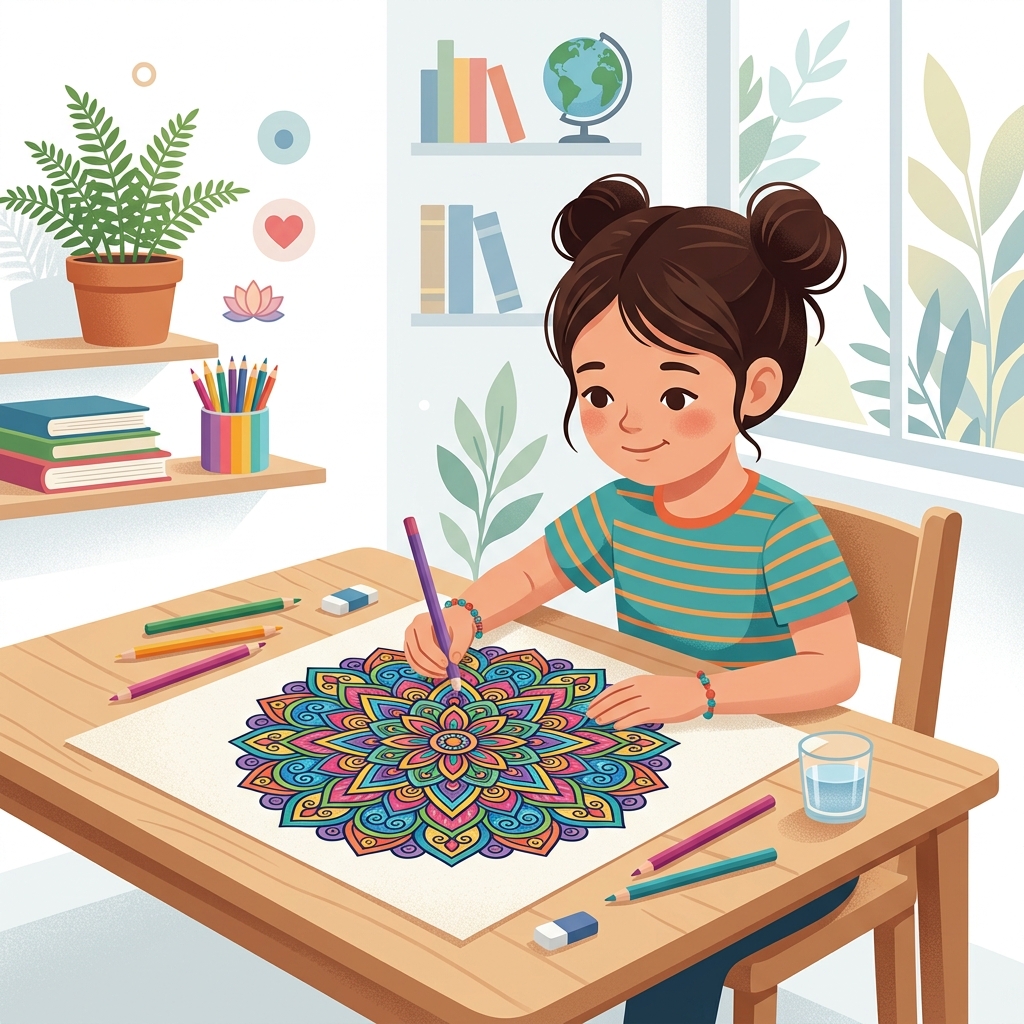
曼陀羅著色與兒童發展:如何透過幾何圖形提升孩子的專注力
發表日期: 2026-05-18
作者: Kiddo Task 育兒科學團隊
在電子產品普及的環境下,孩子每天接觸大量的螢幕刺激。過多的視覺刺激與源源不絕的短影音,縮短了新一代兒童的專注時間。家長與教育工作者如何運用合適的方法,培養孩子的專注力與定力?
答案就在延續數千年的幾何藝術:曼陀羅著色。近年來,曼陀羅著色除了用作靜心活動,在發展心理學與幼兒教育領域,也常被作為訓練兒童專注力與情緒調節的教具。
心理學家榮格(Carl Jung)曾指出:「曼陀羅的圓形核心象徵心靈的本源。透過對稱線條的色彩組合,能促進內在的對話與整合。」
一、榮格心理學:曼陀羅與情緒調節
曼陀羅(Mandala)在梵語中代表「圓」或「中心」。榮格在個人面臨低潮時,透過每天繪製曼陀羅,發現內心焦慮逐漸平息。他指出,圓形結構能產生聚攏效應,呈現內在的心理狀態。
當孩子面對日常壓力或情緒起伏時,常因語言表達不夠成熟而難以宣洩。在著色過程中,色彩的選擇與筆觸的輕重,都是內心情感的投射。對稱的圖案有助於帶來安定感,釋放焦慮情緒,是常用的兒童情緒管理教具。
二、皮亞傑認知理論:從幾何對稱啟發空間邏輯
皮亞傑(Jean Piaget)指出,幼兒主要藉由感官經驗與空間探索來建立對世界的認知。
曼陀羅具有輻射狀對稱與規律的幾何結構。當孩子在紙上著色時,大腦會進行以下認知判斷:
- 對稱感知:孩子會自發發現「左邊塗了藍色,右邊對應位置塗藍色能達成視覺平衡」,這有助於早期數感與守恆概念的發展。
- 空間方位:在多層環狀圖形中著色,能練習辨識空間定位與排列順序。
三、蒙特梭利教育:鍛鍊控筆與精細動作
蒙特梭利教育強調「手腦並用」。在幼兒書寫前的準備階段,感官練習非常重要。
曼陀羅著色是理想的寫前練習。孩子需要在封閉的線條內塗色,需要手腕與手指肌肉協調,並控制運筆力道。這能鍛鍊手指細微肌群,為即將入學的幼兒打下控筆基礎。與在玻璃平板上滑動相比,紙筆摩擦的物理反饋對感官發育更有幫助。
四、親子著色引導步驟
家長與教師可以參考以下方式引導孩子:
- 整理環境:收起發出聲響的電子設備,提供安靜、乾淨的桌面。
- 選擇合適的工具與難度:幼齡兒童(3至5歲)建議提供較粗的蠟筆,並選擇線條簡單的圖案以減少挫折;年長兒童(6歲以上)可提供色鉛筆,挑戰細緻的紋理,練習精細控筆。
- 減少過度干涉:請克制指導色彩的衝動,不說「樹一定要塗綠色」或「這裡塗出界了」。讓孩子自由配色有助於建立信心。
- 交流分享:完成後可以將作品貼出來,詢問孩子:「你最喜歡哪一部分的顏色?畫的時候有什麼感覺?」這能促成溫暖的對話,也是孩子整理情緒的機會。
現在可以到我們的 曼陀羅著色工具頁面 免費生成並列印圖紙,與孩子一起度過安靜的繪畫時光。
Mandala Coloring and Child Development: Enhancing Focus Through Symmetrical Art
Date: 2026-05-18
Author: Kiddo Task Pediatric Research Team
With screens and mobile devices everywhere, children today are exposed to constant visual stimulation. This fast-paced digital environment often shortens their attention span. When children spend hours watching quick videos on phones, their brains get used to instant excitement. As a result, they find it hard to sit still, read a book, or focus on a school task. How can parents and teachers help children develop quiet focus and patience without making them feel forced?
The answer can be found in a geometric art form with a long history: Mandala Coloring. These patterns are not just pretty designs to pass the time. In early childhood education and developmental studies, mandalas are widely used as practical tools. They help children build a longer attention span, improve their physical hand control, and learn to manage their emotions in a calm, natural way.
Psychologist Carl Jung observed: "The circular core of the mandala symbolizes the center of the mind. Designing and coloring these patterns helps the psyche achieve balance and integration."
1. Jungian Psychology: Mandalas and Emotional Regulation
In Sanskrit, "Mandala" means "circle" or "center." Carl Jung found that drawing mandalas daily helped ease his personal anxiety and bring peace to his mind. He noted that circular patterns create a sense of order, reflecting a person's inner psychological state. The circular shape acts like a safe boundary, keeping thoughts from scattering.
When children experience stress, anger, or big emotions, they often struggle to express themselves in words. They might act out, cry, or shut down instead. In mandala coloring, their color choices and pen strokes reflect their inner feelings. For instance, aggressive coloring might show anger, while calm pastel choices might show a need for quiet. Symmetrical designs offer a sense of stability, helping children relax and release tension. This makes mandalas a useful, non-verbal tool for emotional regulation.
2. Piaget's Cognitive Theory: Developing Spatial Logic
Jean Piaget pointed out that young children learn about the world through hands-on sensory experiences and physical exploration. Before they can understand abstract math or science, they need to touch, see, and arrange physical things.
Mandalas feature symmetrical and structured geometric shapes that naturally draw the eye. As children color these patterns, their brains process important spatial and logical relationships:
- Symmetry: Children notice that coloring matching sections with similar colors creates visual balance. This supports early logical thinking and math-related understanding, such as patterns and equality.
- Spatial awareness: Navigating concentric circles helps children practice spatial orientation. They must decide what is "inside," "outside," "next to," or "opposite." This is great practice for visual-spatial skills.
3. Montessori Practice: Fine Motor Skills and Pen Control
Montessori education emphasizes active, hands-on learning. Before learning to write letters, sensory preparation is key. Children do not start writing by copying alphabet sheets. Instead, they build hand strength first.
Mandala coloring serves as an excellent pre-writing activity. Coloring within small, precise boundaries requires fine muscle control in the hand and wrist. This refines the pencil grasp and prepares young fingers for writing letters. Unlike frictionless tablet screens where fingers slide easily, the physical resistance of paper and pencils supports sensory development. It teaches children how much pressure to apply, preventing hand fatigue when they start school.
4. Practical Coloring Tips for Parents and Teachers
Here is a step-by-step approach to get the most out of this tool:
- Set up the space: Remove loud screens and prepare a quiet, clutter-free desk. A calm environment helps children enter a state of deep focus.
- Choose suitable tools: Give younger children (ages 3 to 5) thick crayons and simple outlines to prevent frustration. Older children (ages 6 and up) can use colored pencils for detailed patterns.
- Allow creative freedom: Avoid correcting their choices. There is no need to say "leaves must be green" or "stay inside the lines." Let children choose colors freely to build confidence and joy.
- Share and talk: Display their finished work. Ask them questions like: "Which color combination do you like best? How did you feel while drawing this?" This encourages meaningful conversation and helps them reflect on their feelings.
Visit our Mandala Coloring Tool Page to generate and print your customized design and enjoy a peaceful coloring session together.